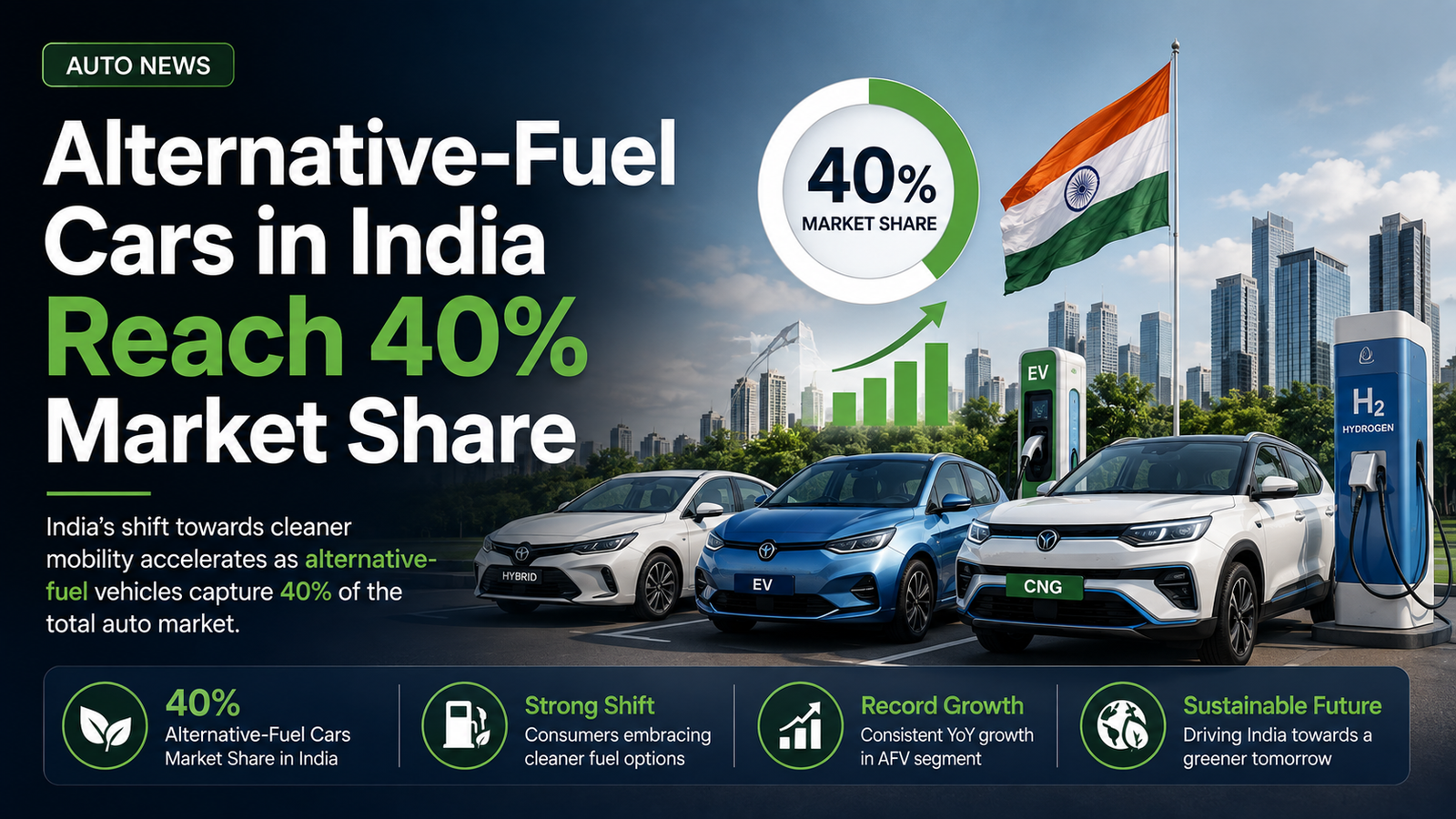
India’s automobile industry is undergoing one of its biggest transformations in decades. Alternative-fuel cars, including electric vehicles (EVs), hybrid cars, and CNG-powered vehicles, now account for nearly 40% of total passenger vehicle sales. The shift comes as rising petrol and diesel prices, coupled with growing environmental awareness and improved vehicle technology, encourage consumers to move away from conventional fuel-powered cars.
What was once considered a niche segment has now become a mainstream choice. While electric vehicles continue to gain momentum, CNG and hybrid models are also playing a crucial role in driving India’s green mobility revolution.
Why Are Alternative-Fuel Cars Becoming More Popular?
Several factors are contributing to the rapid growth of alternative-fuel vehicles in India.
Rising Petrol and Diesel Prices
Higher fuel prices have significantly increased the cost of owning conventional petrol and diesel cars. Consumers are increasingly looking for vehicles with lower running costs.
Lower Cost Per Kilometre
One of the biggest advantages of alternative-fuel vehicles is their lower operating expense.
- EVs generally have the lowest running cost.
- CNG vehicles offer substantial fuel savings compared to petrol.
- Hybrid cars improve fuel efficiency without requiring external charging.
For many buyers, long-term fuel savings now outweigh the higher initial purchase price.
Better Infrastructure
India has witnessed rapid growth in:
- EV charging stations
- CNG filling stations
- Battery technology
- Vehicle servicing networks
Improved infrastructure has made alternative-fuel vehicles more practical for everyday use.
Government Support
Central and state governments continue to promote cleaner mobility through incentives, tax benefits, and investments in charging infrastructure.
Breaking Down the 40% Market Share
The alternative-fuel vehicle market is no longer driven by a single technology.
Electric Vehicles (EVs)
Electric cars continue to record strong growth, especially in urban markets.
Key advantages include:
- Lowest running costs
- Zero tailpipe emissions
- Lower maintenance requirements
- Growing charging infrastructure
Improved battery technology has also increased driving range, making EVs suitable for more consumers.
Hybrid Vehicles
Hybrid cars combine an internal combustion engine with an electric motor.
Their benefits include:
- Better fuel efficiency
- Reduced emissions
- No dependence on charging stations
- Smooth transition for buyers moving away from traditional petrol vehicles
Hybrids have become increasingly attractive for consumers who want fuel savings without worrying about charging availability.
CNG Vehicles
CNG remains one of India’s most popular alternative fuels.
Reasons include:
- Lower fuel prices
- Wide availability in many cities
- Proven technology
- Lower ownership costs
For buyers covering high monthly distances, CNG vehicles continue to offer excellent value.
Is Range Anxiety Still a Major Concern?
For years, range anxiety was considered the biggest obstacle to EV adoption.
Today, that concern is gradually declining due to:
- Longer battery ranges
- Faster charging technology
- Expansion of public charging stations
- Improved reliability of EVs
While charging infrastructure still varies across regions, many urban buyers now view EVs as practical daily-use vehicles.
For consumers who still prefer conventional refuelling, hybrids and CNG cars provide attractive alternatives.
Which Auto Companies Are Benefiting?
Several automobile manufacturers are well positioned to benefit from the shift toward green mobility.
Tata Motors
Tata Motors remains one of India’s leading electric passenger vehicle manufacturers, with a strong portfolio of EV models.
Maruti Suzuki
Maruti Suzuki continues to dominate the CNG segment while also expanding its hybrid and electric vehicle offerings.
Mahindra & Mahindra
Mahindra is investing heavily in electric SUVs and future EV platforms as part of its long-term growth strategy.
Toyota Kirloskar Motor
Toyota has established a strong presence in hybrid technology, with several fuel-efficient hybrid models gaining popularity among Indian buyers.
MG Motor India
MG has expanded its electric vehicle lineup and continues to strengthen its position in the premium EV segment.
What Does This Mean for the Indian Auto Industry?
The rise of alternative-fuel cars is changing how manufacturers design, produce, and market vehicles.
Companies are increasing investments in:
- Battery technology
- Hybrid powertrains
- EV manufacturing
- Charging infrastructure partnerships
- Software and connected vehicle technologies
The competitive landscape is shifting from engine performance alone to overall efficiency, technology, and sustainability.
Challenges That Still Remain
Despite strong growth, several challenges continue to affect adoption.
Higher Purchase Prices
Electric and hybrid vehicles often cost more upfront than comparable petrol models.
Charging Infrastructure
Although expanding rapidly, charging availability remains uneven across smaller cities and rural areas.
Battery Costs
Battery technology continues to represent a significant portion of EV manufacturing costs.
Consumer Awareness
Many buyers still require better information about ownership costs, charging, and maintenance before switching to alternative-fuel vehicles.
What Lies Ahead?
Industry experts expect alternative-fuel vehicles to continue increasing their share of India’s passenger vehicle market over the coming years.
Future growth is likely to be supported by:
- More affordable EV models
- Expansion of charging infrastructure
- Improved battery technology
- Stronger government policy support
- Continued rise in fuel prices
Rather than one technology replacing another, India’s market is expected to remain diverse, with EVs, hybrids, and CNG vehicles serving different customer needs.
Final Thoughts
The fact that alternative-fuel cars now account for nearly 40% of India’s passenger vehicle sales highlights a major shift in consumer preferences. Rising fuel prices, lower running costs, better infrastructure, and technological improvements are encouraging buyers to move beyond conventional petrol and diesel vehicles.
While EVs are attracting significant attention, hybrids and CNG vehicles continue to play a vital role in India’s green mobility transition. As technology improves and infrastructure expands, alternative-fuel vehicles are expected to become an even larger part of the country’s automotive future.
FAQ
What are alternative-fuel cars?
Alternative-fuel cars are vehicles powered by fuels other than conventional petrol or diesel, including electric, hybrid, and CNG-powered vehicles.
Why are alternative-fuel cars becoming more popular in India?
Rising fuel prices, lower running costs, government incentives, and improved infrastructure are encouraging consumers to choose alternative-fuel vehicles.
Which type of alternative-fuel vehicle is most affordable to run?
Electric vehicles generally have the lowest running costs, while CNG vehicles also offer significant fuel savings compared to petrol cars.
Is range anxiety still a major problem for EV buyers?
Range anxiety has reduced considerably due to longer battery ranges, improved charging infrastructure, and advances in fast-charging technology.
Which companies are leading India’s green mobility market?
Major beneficiaries include Tata Motors, Maruti Suzuki, Mahindra & Mahindra, Toyota Kirloskar Motor, and MG Motor India.