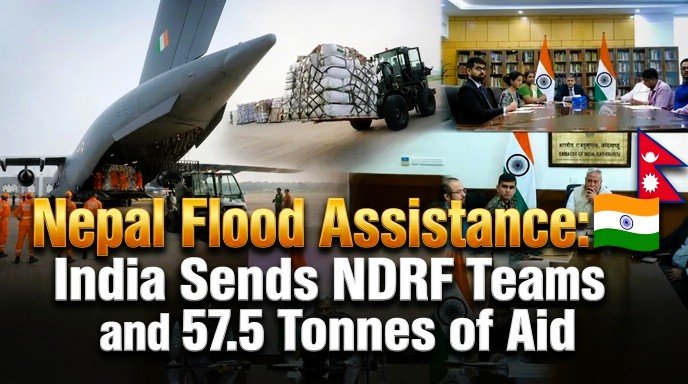
Nepal Flood Assistance: India Sends NDRF Teams and 57.5 Tonnes of Humanitarian Aid
Nepal flood assistance has been stepped up by India as severe flooding and difficult conditions in parts of Nepal have prompted a major humanitarian response.
India has dispatched National Disaster Response Force (NDRF) teams, Bailey bridges and 57.5 tonnes of humanitarian aid to support relief and rescue operations in flood-affected areas.
The operation also includes efforts to assist Indian citizens who have been stranded in difficult-to-reach areas near the Nepal-China border.
India Steps Up Nepal Flood Assistance
India’s response forms part of a broader effort to provide immediate assistance to Nepal during the ongoing flood situation.
The relief package includes specialised NDRF teams equipped to support search-and-rescue operations, along with Bailey bridges that can help restore connectivity in areas where roads and permanent bridges have been damaged.
India has also sent 57.5 tonnes of humanitarian assistance to support people affected by the disaster.
The assistance highlights the close relationship between India and Nepal and India’s role in providing emergency support during major natural disasters in the region.
What Has India Sent to Nepal?
As part of its Nepal flood assistance, India has deployed several forms of emergency support.
These include:
- NDRF rescue and relief teams
- Bailey bridges
- 57.5 tonnes of humanitarian supplies
- Emergency assistance for affected communities
- Support for stranded Indian citizens
The combination of rescue personnel, infrastructure equipment and humanitarian supplies is intended to address both immediate relief requirements and connectivity challenges.
Why Bailey Bridges Are Important
Bailey bridges are temporary, modular bridges that can be assembled relatively quickly.
They are particularly useful during disaster situations when existing bridges have been damaged or washed away.
Restoring road connectivity is crucial because rescue teams, medical personnel and relief supplies need reliable access to affected communities.
The deployment of Bailey bridges as part of India’s Nepal flood assistance could therefore help improve the movement of people and emergency supplies in affected areas.
NDRF Teams Support Rescue Operations
The NDRF specialises in disaster response and search-and-rescue operations.
Its teams are trained to operate in challenging conditions, including floods, landslides and other natural disasters.
Their deployment to Nepal is aimed at supporting local authorities and assisting with rescue and relief activities.
The presence of specialised teams can be particularly important when affected areas are difficult to access or when local resources are stretched by the scale of a disaster.
57.5 Tonnes of Humanitarian Aid
India has also dispatched 57.5 tonnes of humanitarian aid to Nepal.
During a major flood emergency, essential supplies can become difficult to access because roads and transportation networks may be disrupted.
Humanitarian assistance can help affected communities meet immediate needs while local authorities work to restore normal services.
The aid forms an important part of India’s wider relief effort alongside rescue personnel and infrastructure support.
Indian Citizens Stranded Near Nepal-China Border
The situation has also raised concerns about Indian nationals who were stranded near the Nepal-China border.
According to the Ministry of External Affairs, more than 400 Indians stranded in the area have been confirmed safe.
At the same time, around 320 individuals remain untraceable, according to the information provided.
Efforts are continuing to establish contact with those who cannot currently be located.
Government Efforts to Locate Missing Individuals
Locating people in disaster-affected and remote areas can be challenging.
Flooding, damaged roads, communication disruptions and difficult terrain can all complicate rescue and communication efforts.
Authorities are therefore working to gather information and establish the whereabouts of people who remain untraceable.
The safety confirmation of more than 400 Indians provides some reassurance, but the status of those still unaccounted for remains a major concern.
India-Nepal Relations and Humanitarian Cooperation
India and Nepal share a close relationship based on geographical proximity, historical connections and extensive people-to-people ties.
Natural disasters often create opportunities for the two countries to work together through humanitarian assistance and emergency response.
India has previously provided disaster relief and rescue support to neighbouring countries during major emergencies.
The current Nepal flood assistance effort is another example of regional humanitarian cooperation.
Challenges During Flood Relief Operations
Flood relief operations can be extremely difficult, particularly in mountainous and remote areas.
Heavy rainfall can cause rivers to overflow, damage roads and isolate communities.
Rescue teams may also face challenges involving weather conditions, unstable terrain and limited communication.
This makes rapid deployment of trained personnel and emergency infrastructure especially important.
Restoring Connectivity Is a Priority
One of the biggest challenges following severe flooding is restoring transportation links.
When bridges and roads are damaged, relief supplies may not reach affected communities quickly.
Temporary infrastructure such as Bailey bridges can provide an immediate solution while permanent repairs are planned.
Improved connectivity can also help rescue teams reach people who may otherwise remain isolated.
India’s Broader Humanitarian Role
India’s response to the Nepal floods reflects its broader approach towards humanitarian assistance in the region.
The combination of personnel, equipment and supplies allows relief operations to address multiple challenges simultaneously.
While NDRF teams focus on rescue and emergency response, humanitarian supplies can support affected communities and temporary infrastructure can help reconnect isolated areas.
What Happens Next?
The immediate priority will be to support rescue operations, provide essential supplies and help restore connectivity in affected areas.
Authorities will also continue efforts to locate the approximately 320 people who remain untraceable.
The situation is expected to remain closely monitored as relief teams assess the extent of damage and identify additional requirements.
India’s support can provide Nepal with additional capacity during a difficult period while local agencies continue leading the broader disaster response.
Nepal Flood Assistance: Key Takeaway
The latest Nepal flood assistance effort demonstrates India’s rapid mobilisation of disaster-response resources for its neighbouring country.
The deployment of NDRF teams, Bailey bridges and 57.5 tonnes of humanitarian aid is aimed at supporting rescue operations, restoring connectivity and helping communities affected by flooding.
The safety confirmation of more than 400 Indians near the Nepal-China border is encouraging, although around 320 people remain untraceable.
As rescue and relief operations continue, coordination between Indian and Nepalese authorities will remain critical to reaching affected communities and ensuring the safety of those still unaccounted for.
Frequently Asked Questions (FAQs)
1. What is India’s Nepal flood assistance?
India’s Nepal flood assistance includes NDRF teams, Bailey bridges and 57.5 tonnes of humanitarian aid to support rescue, relief and connectivity restoration efforts.
2. How much humanitarian aid has India sent to Nepal?
India has dispatched 57.5 tonnes of humanitarian aid as part of its relief response.
3. Why are NDRF teams being sent to Nepal?
NDRF teams are being deployed to support search-and-rescue and emergency relief operations in flood-affected areas.
4. What are Bailey bridges?
Bailey bridges are temporary modular bridges that can be assembled relatively quickly and are commonly used to restore connectivity after roads or permanent bridges are damaged.
5. How many Indians have been confirmed safe?
The Ministry of External Affairs has confirmed that more than 400 Indians stranded near the Nepal-China border are safe.
6. How many people remain untraceable?
Around 320 individuals remain untraceable, according to the information provided by the authorities.
7. Why is locating stranded people difficult?
Flooding, damaged roads, difficult terrain and communication disruptions can make it challenging for authorities to establish contact with people in remote areas.
8. Why is India’s assistance to Nepal significant?
India and Nepal share close geographical and people-to-people ties. Humanitarian assistance during a natural disaster strengthens cooperation and provides additional resources for emergency response.
9. What is the priority of the relief operation?
The immediate priorities are rescue and safety, delivery of essential supplies, restoration of connectivity and locating people who remain unaccounted for.
10. Will India’s relief efforts continue?
Relief and rescue operations are expected to continue as authorities assess the situation and determine further requirements in the flood-affected areas.