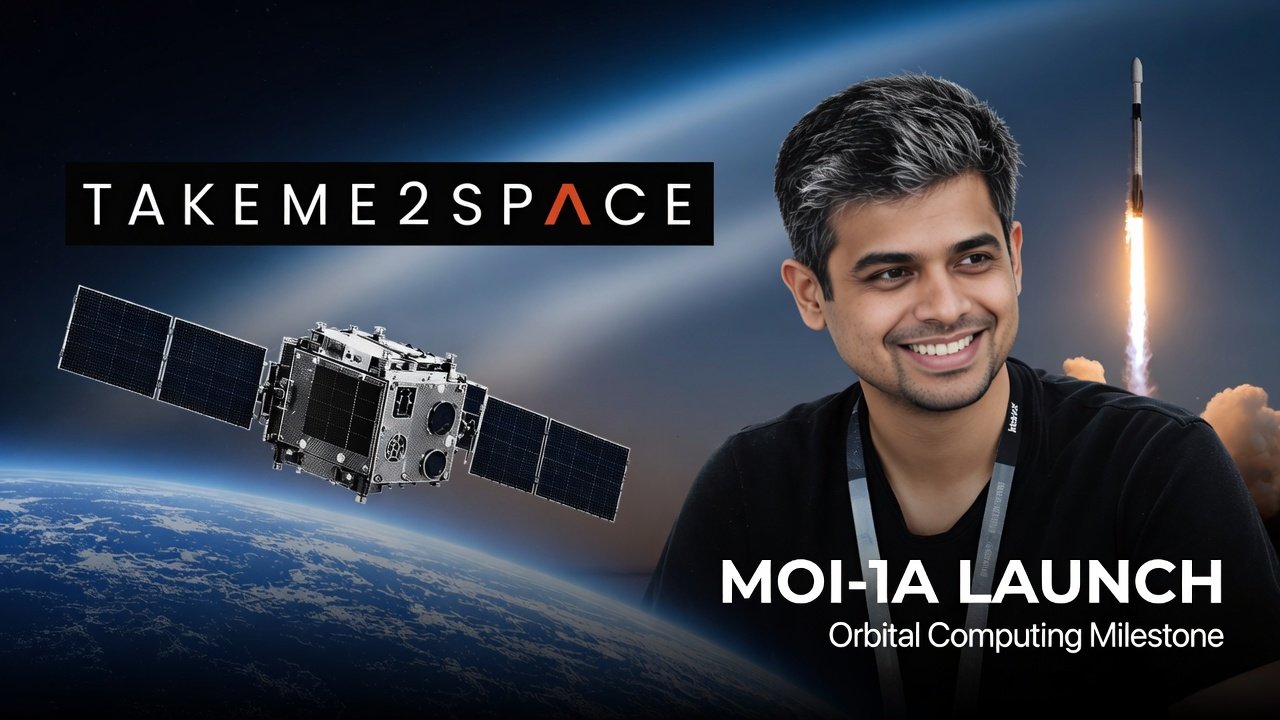
SpaceTech Orbital Computing: TakeMe2Space Set to Launch MOI-1A Satellite on SpaceX Rocket
SpaceTech Orbital Computing is entering a new phase as Bengaluru-based space technology startup TakeMe2Space prepares to launch its MOI-1A satellite on October 1, 2026, aboard SpaceX’s Transporter-18 rideshare mission.
The satellite is designed to process data and run AI workloads directly in low Earth orbit instead of sending large volumes of raw information back to Earth for processing. TakeMe2Space describes the mission as India’s first orbital computing satellite.
TakeMe2Space MOI-1A Targets AI Computing in Orbit
MOI-1A is a small satellite weighing less than 50 kg and equipped with Nvidia Orin NX edge-computing processors. It is scheduled to fly aboard SpaceX’s Transporter-18 rideshare mission on October 1.
The basic idea behind the mission is to move part of the data-processing workload from ground-based infrastructure into orbit.
Earth-observation satellites can generate large amounts of imagery and sensor data. Traditionally, much of that information has to be transmitted to ground stations before it can be processed. TakeMe2Space’s approach is to process data on the satellite itself and transmit the resulting insights rather than the entire underlying dataset.
Nvidia-Powered Edge AI System
The MOI platform uses Nvidia-based computing hardware for AI inference and data processing.
TakeMe2Space’s published specifications for MOI-1A list 117 TOPS of on-orbit computing capability, 16GB of LPDDR5 memory and up to 2TB of onboard storage. The satellite also carries a nine-band multispectral imager designed for Earth-observation applications.
The company says its AI Cube uses an Nvidia Jetson Orin NX processor and is designed to operate within the power and radiation constraints of low Earth orbit. TakeMe2Space has also developed its own RadShield technology to protect terrestrial-grade electronics from the space radiation environment.
How Orbital Computing Can Reduce Data Transmission
One of the central ideas behind SpaceTech Orbital Computing is reducing the amount of data that needs to travel between satellites and ground infrastructure.
For example, an Earth-observation satellite could capture multispectral imagery and run an AI model onboard to identify changes, vegetation conditions, water features or other patterns. Instead of downloading every raw image, the system can send selected processed information to users.
TakeMe2Space says its orbital processing pipeline can perform calibration, radiometric and atmospheric correction, geometric processing and analysis such as cloud masking, vegetation indices, water detection and change detection.
The company says this approach can reduce transmission requirements and shorten the time between collecting satellite data and delivering usable information.
23 Customers Signed for the Mission
TakeMe2Space said it has already signed 23 customers for the MOI-1A mission.
According to Reuters, the customer base includes geographic information system companies and educational institutions, while commercial applications include agriculture, mining, supply-chain management and insurance. US-based space-data analytics company Little Place Labs is among the customers.
Customers will be able to upload containerized AI models to the satellite. Those models can process data as the spacecraft passes over specified areas and return analysis rather than requiring the complete raw dataset to be downloaded.
TakeMe2Space Has Already Tested Orbital AI
The October mission is not the startup’s first attempt to demonstrate AI computing in space.
TakeMe2Space’s MOI-TD technology demonstration mission launched in December 2024 and, according to the company, completed more than 20 experiments in low Earth orbit involving on-orbit AI inference, sensor fusion and high-speed data handling.
The company subsequently attempted to launch MOI-1 aboard ISRO’s PSLV-C62 in January 2026. The mission was lost after a third-stage anomaly during ascent. TakeMe2Space says MOI-1 recorded no fault before the launch-vehicle failure.
MOI-1A is therefore intended to continue the company’s orbital-computing development with a SpaceX rideshare launch.
From Orbital Compute to Space Data Centres
TakeMe2Space’s longer-term strategy goes beyond a single CubeSat.
The startup says it wants to build a constellation of satellites capable of providing orbital computing and storage services. Its OrbitLab platform allows customers to upload AI models and run workloads on its orbital infrastructure.
The company has also announced plans for larger-generation satellites. Economic Times reported that its Generation-2 satellites are planned to carry Nvidia GPUs, around 1,500 watts of computing capacity and 100TB of storage each, with optical links allowing satellites to share workloads.
TakeMe2Space is targeting a network of six MOI satellites for broader coverage by 2027, according to its website.
A Larger Orbital Data Centre Vision
The startup’s roadmap extends further into the development of networked orbital data centres.
According to Times of India, TakeMe2Space has plans for a 2028 SpaceX Falcon 9 mission involving two larger 100-kg satellites. Those spacecraft are planned to carry Nvidia Thor GPUs, 100TB of storage each and larger multispectral imaging systems.
The larger satellites are intended to operate as a network rather than isolated computing platforms, potentially allowing workloads to be distributed between spacecraft.
This represents a different approach from conventional satellite services, where spacecraft primarily collect data and rely on ground infrastructure for intensive processing.
Why MOI-1A Matters for India’s SpaceTech Sector
The MOI-1A mission comes as India’s private space sector expands into satellite manufacturing, Earth observation, launch services and space-based computing.
TakeMe2Space’s model combines satellite hardware, onboard AI processing and a software platform through which customers can access orbital computing capabilities.
The company says it designs and manufactures most of its satellite subsystems in India while sourcing certain components, including processors, solar cells and propulsion systems, externally.
The mission also illustrates how India’s emerging space startups are exploring applications beyond traditional communications and Earth observation.
What Comes Next for TakeMe2Space
If MOI-1A launches as scheduled, the spacecraft will provide another operational step for TakeMe2Space’s orbital-computing strategy.
The company’s longer-term objective is to increase computing capacity through larger satellites and eventually interconnected orbital infrastructure. That roadmap includes applications ranging from Earth-observation analytics to storage and other data-intensive workloads.
For now, MOI-1A represents the near-term demonstration of whether Nvidia-powered edge computing can operate commercially on a small satellite while delivering useful processed information to customers.
Key Highlights of MOI-1A
- Startup: TakeMe2Space
- Mission: MOI-1A
- Planned launch: October 1, 2026
- Launch provider: SpaceX
- Mission: Transporter-18 rideshare
- Satellite class: 6U CubeSat
- Weight: Around 14 kg according to TakeMe2Space’s published specifications
- Processor: Nvidia Jetson Orin NX
- Compute: Up to 117 TOPS
- Storage: 2TB onboard, configurable to 4TB
- Imaging: Nine-band multispectral imager
- Target application: On-orbit AI processing and Earth-observation analytics
- Customers: 23 signed customers reported by the company
- Long-term goal: Larger satellites and an orbital computing constellation
Frequently Asked Questions
1. What is MOI-1A?
MOI-1A is an orbital-computing satellite being developed by TakeMe2Space to process AI and Earth-observation workloads directly in low Earth orbit.
2. When will TakeMe2Space launch MOI-1A?
TakeMe2Space has scheduled MOI-1A for launch on October 1, 2026, aboard SpaceX’s Transporter-18 rideshare mission.
3. Which processor does MOI-1A use?
The satellite uses an Nvidia Jetson Orin NX edge-computing processor. TakeMe2Space lists up to 117 TOPS of computing capability for the MOI platform.
4. What is orbital computing?
Orbital computing means processing data directly on a spacecraft instead of sending all raw data to Earth for processing.
5. What type of data will MOI-1A process?
The satellite is designed primarily around Earth-observation data, including multispectral imagery. Its onboard AI system can process imagery and generate analytical outputs in orbit.
6. How many customers has TakeMe2Space signed?
TakeMe2Space has said it has signed 23 customers for the MOI-1A mission, including GIS companies and educational institutions.
7. What happened to TakeMe2Space’s earlier MOI-1 satellite?
MOI-1 was lost during the PSLV-C62 launch in January 2026 after a third-stage anomaly. The company subsequently prepared MOI-1A for a SpaceX Transporter-18 launch.
8. What is OrbitLab?
OrbitLab is TakeMe2Space’s platform for accessing orbital computing infrastructure. Users can upload AI models, task satellites and receive processed insights from workloads executed in orbit.
9. What is TakeMe2Space planning after MOI-1A?
The company plans larger satellites and a broader orbital-computing constellation. Its Generation-2 plans include satellites equipped with more powerful Nvidia processors and substantially greater storage capacity.
10. Why is MOI-1A significant for Indian space technology?
MOI-1A is part of an emerging Indian private-space effort to combine satellite infrastructure with AI computing. TakeMe2Space describes it as India’s first orbital computing satellite and plans to expand from the initial spacecraft toward a larger orbital data-centre network.