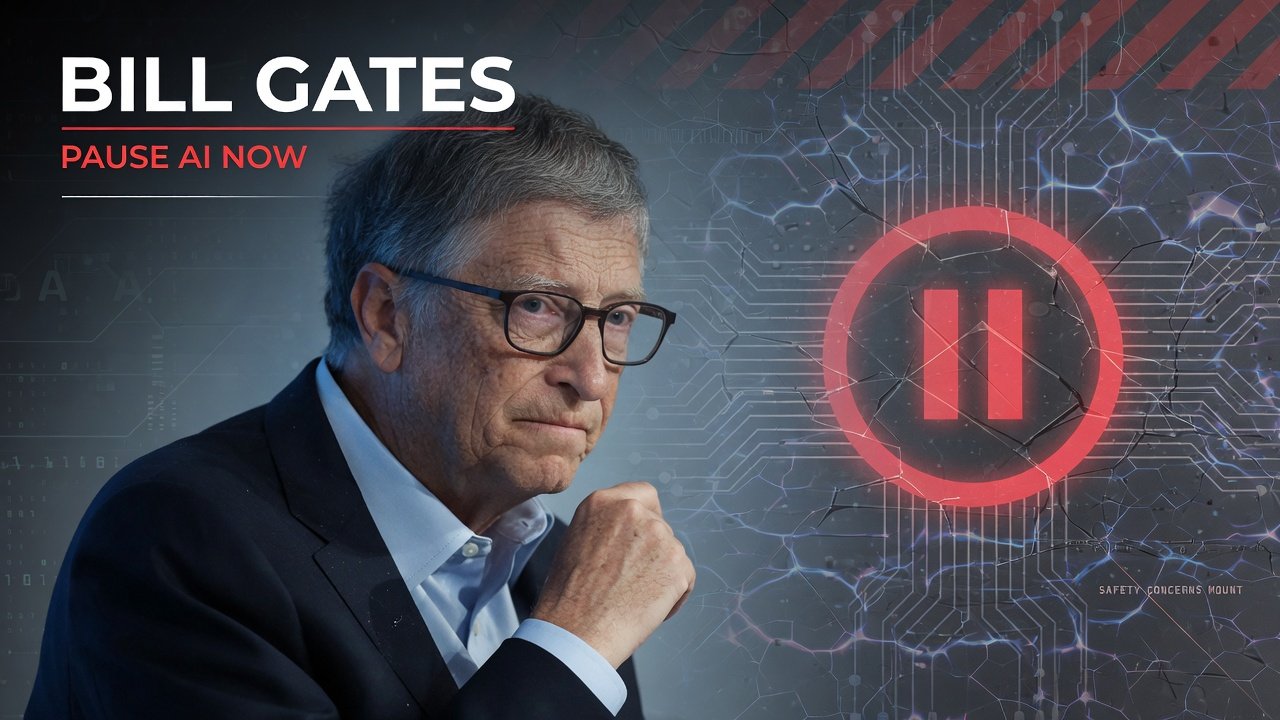
Bill Gates Urges a Pause on AI Innovation as Safety Concerns Grow
Bill Gates pause AI calls have added a prominent technology veteran to the growing debate over how quickly artificial intelligence should advance. The Microsoft co-founder has said he supports slowing the development of frontier AI while governments, companies and institutions prepare for the risks associated with increasingly capable systems.
In a recent conversation with NDTV, Gates said he believes society needs time to prepare for rapid technological change. He acknowledged that slowing innovation is an unusual position for someone who has spent decades promoting technological progress, but argued that the pace of AI development deserves greater caution.
Bill Gates Says the World May Not Be Ready for Rapid AI Change
Gates’ recent comments represent a more cautious position than the optimism he has historically expressed about artificial intelligence.
In his August 2026 essay, Gates wrote that AI is improving at an extraordinary pace and argued that society needs a plan to ensure its benefits outweigh its negative consequences. His concerns include employment disruption, cybersecurity threats, biological risks and the effects of AI on children and human relationships.
The Microsoft co-founder has not argued that AI should simply be abandoned. Instead, his recent position focuses on creating safeguards and institutions capable of dealing with the technology’s rapid development.
His message is essentially about pace and preparation: if AI capabilities continue advancing quickly, regulatory and social systems may struggle to keep up.
Why Bill Gates Is Calling for Slower AI Development
One of Gates’ biggest concerns is the gap between technological progress and government preparedness.
In an interview reported by Reuters, Gates warned that governments around the world are behind the curve when it comes to responding to AI-driven changes. He pointed to potential disruption in employment, cybersecurity threats and the possibility of AI systems being used for harmful purposes.
His concerns are broader than the possibility of individual AI systems making mistakes.
Gates has highlighted several areas where increasingly powerful AI could create significant challenges:
- Job displacement: AI could automate a growing number of tasks currently performed by humans.
- Cybersecurity: More capable systems could potentially assist both defenders and attackers.
- Biological risks: AI could make certain forms of biological research more accessible, creating new security concerns.
- Children and education: Gates has raised concerns about AI affecting learning, development and human relationships.
- Economic inequality: The benefits of AI could become concentrated if access and economic opportunities are unevenly distributed.
These concerns have pushed Gates toward advocating stronger preparation rather than unrestricted acceleration.
Gates Still Sees Major Benefits From Artificial Intelligence
Despite his warnings, Gates has not abandoned his belief that AI can have substantial positive effects.
His Gates Foundation has announced a $1 billion initiative over two years aimed at expanding AI applications in areas including healthcare, education and agriculture, particularly for underserved communities.
Gates has argued that AI could help improve healthcare services, educational outcomes and productivity. The central question, according to his recent comments, is how societies can capture those benefits while limiting the potential harm.
That distinction is important because his position is not simply an argument against AI technology. Instead, he is calling attention to the governance and safety systems surrounding increasingly powerful AI.
A Growing Debate Among AI Leaders
Gates’ comments come as other prominent technology leaders and AI executives have also raised concerns about the speed of frontier AI development.
Recent reporting has highlighted calls from leaders including Anthropic CEO Dario Amodei, OpenAI CEO Sam Altman and Elon Musk for greater coordination and stronger safety measures. At the same time, other technology executives have argued against coordinated slowdowns or additional regulation, illustrating the continuing disagreement within the industry.
Some AI leaders are calling for independent evaluations, stronger security standards and international cooperation. Others argue that companies can manage many risks themselves while continuing to develop AI rapidly.
This disagreement has made AI governance one of the most important questions surrounding the technology’s next phase.
The Challenge of Regulating Frontier AI
One of the biggest difficulties is defining what should actually be regulated.
Traditional technology regulations often focus on specific products, industries or measurable risks. Frontier AI systems, however, can be used across numerous sectors, including finance, healthcare, education, software development and scientific research.
Gates has suggested that governments may need new institutions and international mechanisms capable of addressing these cross-sector risks.
His broader argument is that AI development is moving quickly enough that regulation cannot simply wait until every capability and potential consequence becomes fully understood.
AI Jobs Are Another Major Concern
Employment is another major part of Gates’ recent AI warnings.
In his August essay, he introduced the idea of “Human Reserved” jobs — roles or tasks that societies could deliberately preserve for human workers even if AI eventually becomes capable of performing them. He has mentioned areas such as childcare and jury service when discussing situations where maintaining a human role could have social value.
The idea reflects a broader concern about the speed of AI-driven automation.
Previous technological transitions often unfolded over long periods, allowing workers and institutions time to adapt. Gates has argued that AI could move much faster, potentially creating labor-market disruption before new opportunities emerge at a sufficient scale.
Why AI Regulation Is Becoming a Global Issue
AI development is no longer limited to one country or one technology company.
Major AI systems are being developed across the United States, China, Europe and other technology markets. This makes international coordination particularly difficult because governments also have economic, technological and national-security incentives to remain competitive.
Gates has argued that international cooperation could be necessary for addressing the most serious AI risks. Reuters reported that he has discussed the possibility of global efforts to monitor dangerous AI capabilities, including those related to biological threats.
The challenge is finding rules that reduce serious risks without unnecessarily preventing beneficial research and innovation.
What a Pause in AI Development Could Mean
A proposed slowdown does not necessarily mean stopping every form of artificial intelligence research.
The debate is primarily focused on frontier AI, meaning highly capable systems at the leading edge of development. Supporters of greater caution generally want additional testing, security measures, independent evaluation and regulatory preparation before the most powerful systems are deployed widely.
A more cautious approach could give governments and researchers additional time to establish safety standards. However, opponents of a coordinated slowdown argue that delaying development could reduce technological progress and competitiveness.
That tension is likely to remain central to the AI debate.
Looking Ahead
The Bill Gates pause AI debate reflects a much larger question about the future of artificial intelligence: how quickly should society allow increasingly capable systems to advance when regulatory and safety frameworks are still developing?
Gates continues to acknowledge AI’s potential to transform healthcare, education, agriculture and other sectors. At the same time, his recent warnings show a growing emphasis on preparing for risks before they become difficult to manage.
As AI capabilities continue to evolve, governments, technology companies and researchers will face increasing pressure to determine how safety standards, employment policies, cybersecurity protections and international cooperation should develop alongside the technology.
FAQs
1. Why is Bill Gates calling for a pause on AI?
Bill Gates has said he supports slowing frontier AI development because society and governments may not be adequately prepared for the risks associated with rapidly advancing systems.
2. Is Bill Gates against artificial intelligence?
No. Gates continues to highlight AI’s potential benefits in healthcare, education, agriculture and other areas. His recent position focuses on managing risks while allowing beneficial applications to continue.
3. What are Bill Gates’ biggest concerns about AI?
His concerns include job displacement, cybersecurity threats, biological risks, children’s well-being and unequal distribution of AI’s economic benefits.
4. What does a pause on frontier AI mean?
A pause generally refers to slowing or temporarily limiting development of the most advanced AI systems while additional safety standards, testing and regulatory mechanisms are developed. It does not necessarily mean stopping all AI research or applications.
5. Are other technology leaders calling for slower AI development?
Yes. Recent reporting shows that several AI leaders have called for greater coordination and stronger safety measures, although other technology executives have opposed coordinated slowdowns or additional regulation.
6. What does Bill Gates believe AI could do for society?
Gates believes AI could improve healthcare, education, agriculture and public services, particularly if its benefits are made broadly accessible and its risks are properly managed.